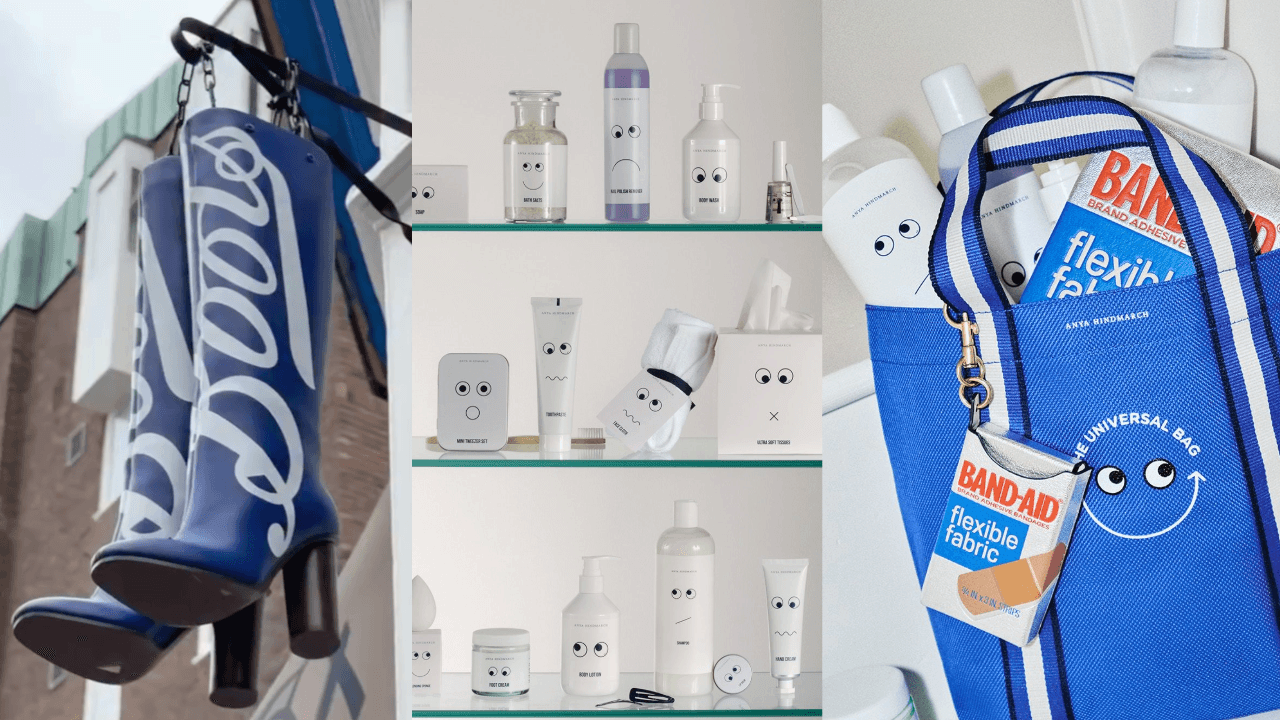

Not because it's cute — although it is — but because of what it says about brand strategy in 2026. About how the smartest brands are moving. About what collaboration, nostalgia, and accessible pricing can do when they're used with intention rather than desperation. Let's break it down.
What Actually Happened
In January 2026, Anya Hindmarch — the designer behind some of Britain's most covetable leather handbags — opened a 1970s-inspired concept store inside her Village Hall on Pont Street, Knightsbridge. The twist: it was a Boots.
Not a Boots pop-up inside her store. A full creative reimagining of what Boots looked like in the 1970s, with retro tiling, staff in crisp white coats, arched wooden windows, and dispensary-inspired packaging. Every detail pulled from Boots' own archive.
And the product range? Shampoo. Cotton wool. Hand lotion. Tweezers. Priced between £5 and £10. Covered in Hindmarch's signature animated eyes. Designed to, as she put it, "pep up your bathroom in January when we all need a lift."
It ran until March 8. It became a cultural moment. And it taught us more about brand growth than most strategy decks we've read this year.
Lesson One: Nostalgia Is a Growth Strategy, Not a Gimmick
The temptation, when you hear "1970s-inspired concept store," is to roll your eyes. Nostalgia in marketing is everywhere. Most of it is lazy — slap a vintage filter on something, call it heritage, move on.
This was different.
Hindmarch didn't reach for generic retro aesthetics. She went into Boots' actual archive. She studied the original packaging, the original signage, the original shop interiors. She reconstructed something specific — not "the feeling of the past" but the particular texture of a Boots pharmacy in 1975.
That specificity is what made it resonate. Nostalgia works when it's precise. When it triggers a real memory rather than a vague feeling. When it says "we know exactly what this was" rather than "wasn't the past nice."
For any brand sitting on heritage — a founding story, an original product, a founding year — this is the lesson. Your archive is not a dusty liability. It's a growth asset. You just need to know how to activate it.
Lesson Two: Collaboration Is the Most Underused Media Channel
Most brands think about collaboration as a product exercise. Two brands make something together, split the hype, move on.
Anya Hindmarch x Boots wasn't a product exercise. It was a media strategy.
Think about what this collaboration actually generated: editorial coverage in fashion media, beauty media, retail media, and lifestyle media simultaneously. Organic social content from thousands of visitors photographing the store. PR value that no single ad campaign could replicate at that cost. And a product line that moved from an exclusive physical pop-up to boots.com for a second wave of demand.
One collaboration. Four distribution channels. A story that wrote itself.
The question every brand should be asking isn't "should we collaborate?" It's "who do we collaborate with to access audiences we can't reach alone, and what story does that collaboration tell that neither of us could tell by ourselves?"
Boots accessed Hindmarch's design-conscious, cultural audience. Hindmarch accessed Boots' scale, footfall, and emotional place in British life. Neither could have bought that access through paid media alone.
That's the model. And it's replicable at almost any budget.
Lesson Three: Accessible Pricing Is a Brand Statement
Here's what most luxury brands get wrong about accessible product lines: they treat them as compromise.
A secondary range. A "masstige" play. Something slightly embarrassing that's mentioned quietly while the real margin lives in the £800 handbags.
Hindmarch did the opposite. The £5-£10 Boots range wasn't a concession — it was the point. It was the boldest creative statement in the collaboration. The idea that great design should animate your bathroom in January. That you don't need to spend £500 to own something with genuine thought behind it.
This reframing — from "affordable version of the brand" to "the brand, democratised" — is what separates brilliant accessible lines from embarrassing ones.
And it works commercially. The initial collection sold out in the physical store. It transitioned online. It built demand. Accessible pricing, executed with conviction, doesn't dilute a brand. It extends it.
Lesson Four: Physical Retail Still Creates Culture
We work in digital. Paid media, AI systems, software, e-commerce — we live in the online stack. And we'll be the first to tell you that digital is where growth compounds.
But this collaboration reminded us of something important: physical retail, done right, is still the most powerful content creation engine available.
The Boots Village Hall wasn't a shop. It was a set. Every element — the tiling, the white coats, the vintage artefacts from Boots' archive — was designed to be photographed, shared, and talked about. The physical experience generated digital content at scale, without a paid amplification budget.
This is the new logic of experiential retail. You're not building a store. You're building a story that people carry out with them and share. The footfall is the media buy.
For brands thinking about retail partnerships, pop-ups, or any kind of physical activation — the question isn't "how many people will walk through the door?" It's "how many people will share what they saw?"
What This Means for Your Brand
You don't need Anya Hindmarch's name recognition or Boots' 177-year archive to apply these principles. You need clarity on three things:
Your story. What's specific and true about how your brand started, what it stands for, or where it comes from? That specificity is the raw material for every activation, collaboration, and campaign worth building.
Your right partner. Not the biggest brand you can reach, but the most interesting combination you can create. Who has the audience you need? Who adds a dimension to your story that you can't add alone?
Your conviction. The Anya Hindmarch x Boots collaboration worked because everyone involved took it seriously. The archive research was real. The design was deliberate. The pricing was a statement, not an afterthought. Half-hearted collaborations produce half-hearted results.
At The Blank Works, this is the kind of strategic thinking we bring to every brand we work with — whether we're running paid media, building AI systems, developing software, or working inside our own Venture Studio to build brands like Ellomatt from the ground up.
The best growth strategies aren't the loudest ones. They're the most considered ones.
The £5 shampoo with the googly eyes proved that.
Let’s keep in touch.
Discover more about high-performance web design. Follow us on Twitter and Instagram.




